Spin axis
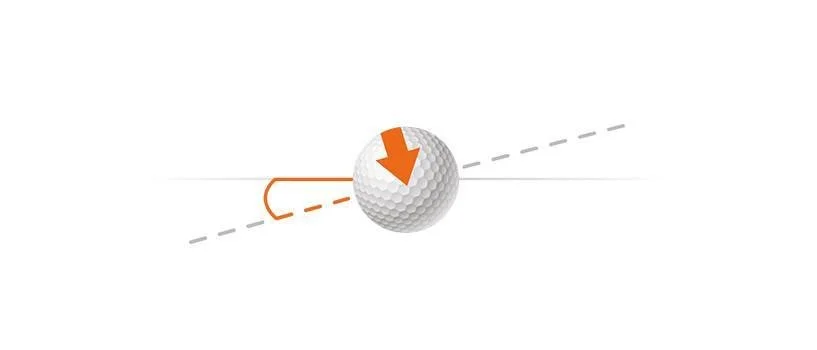
It determines how the ball will curve through the air.
A negative spin axis means the ball curves to the left; a positive spin axis means the ball curves to the right; and a zero spin axis means the ball flies in a perfectly straight line.
The spin axis is measured at the moment of impact with the ball and remains unchanged throughout the flight. Although the wind may “push” the ball in various directions, the spin axis remains unchanged. This value is defined relative to the horizon.
This value can be easily illustrated using an airplane’s wings. If the wings are parallel to the ground, this would be an example of a spin axis equal to zero, and the airplane flies straight. If the wings are not at the same height (e.g., the right wing is higher than the left), this indicates a negative spin axis, which will cause the airplane to turn to the left. Similarly, if the left wing is higher, the airplane will turn to the right.
As a general rule, a spin axis between -2 and 2 can be considered a relatively straight shot. Under normal conditions, it would be difficult to see any curve with such values. Only higher numbers would result in the ball curving through the air.
Examples of spin axes
A shot at 135 meters
-2 spin axis ≈ 2.0 meters of left-hand spin
-10 spin axis ≈ 10 meters of left-hand spin
2 spin axis ≈ 2.0 meters clockwise
10 spin axis ≈ 10 meters of right-hand turn
A shot at 180 meters
-2 spin axis ≈ -2.7 meters of left-hand spin
-10 spin axis ≈ -13.7 meters of left-hand spin
2 spin axes ≈ 2.7 meters of clockwise rotation
10 spin axes ≈ 13.7 meters of clockwise rotation