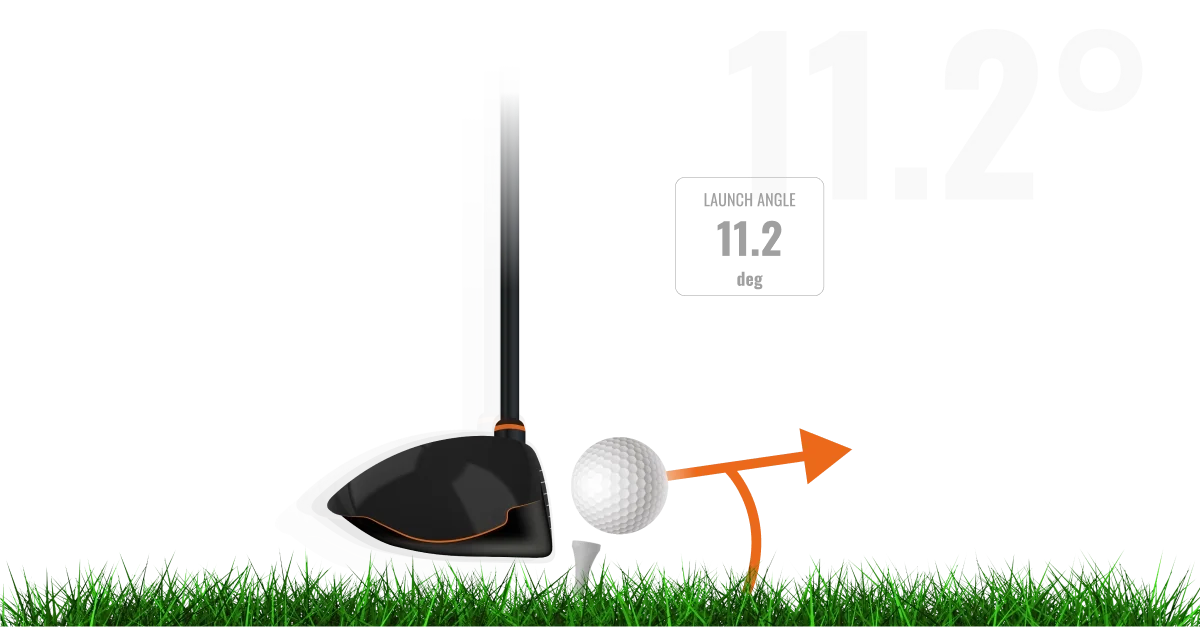
The definition is as follows: Launch Angle (the angle at which the ball is launched) is the angle between the horizon and the initial trajectory of the golf ball at the moment it is struck by the club.
Or, to put it more simply?
Launch angle is simply the way the ball takes off from the clubface after contact. It can take off very low, almost at ground level, or high, as if it were trying to fly into space. This angle is—roughly speaking—the result of the combination of the angle of attack, the club’s lie angle, and the point of contact on the clubhead.

A low launch angle means that the ball takes off flat and travels closer to the ground for a longer distance
A high launch angle, in turn, results in a high launch, causing the ball to rise quickly into the air.
Professionals have complete control over the launch angle. For example:
Driver: 10–12°
7-iron: 15–17°
PW: 25–28°
As you can see, the more loft a club has, the higher the launch angle. But that’s not all. Of course, you may prefer a higher ball flight (on soft courses) or a lower one (on links courses)—in any case, the point is to consciously control this parameter.
For example, these are the optimal launch angle values for 7-iron shots with different swing speeds:
60 mph:
70 mph:
80 mph:
90 mph:
Launch angle isn't a value that stands alone. Whether the ball launches too high or too low determines whether you’ll be able to realize the full potential of your swing. The optimal launch angle is the one that matches your swing speed and the club you’re using. And that’s exactly what sets a pro apart from an amateur—a pro knows how to keep the launch angle within the range that gives him maximum distance and control.
If your ball speed is relatively low and your launch angle is too low, the ball will drop quickly to the ground, losing distance. A higher launch angle will cause the ball to stay in the air longer, which will result in more distance.
The opposite is true for high ball speeds —if the launch angle is too high, the ball will spend more time flying “into space” instead of moving forward.
Check out the most common mistakes:
Mistake #1: Holding the stick too low
Launch is too low
Low contact = low trajectory. The proverbial “grounder,” when the ball travels along the ground instead of rising into the air.
Mistake #2: Landing net
Launch is too high
If your hands stay back at impact, the clubhead generates more loft than it should. The ball takes off high.
Mistake #3: Throwing the ball
Launch is too low
An aggressive “swing” at the ball can cause the club’s loft to practically disappear. The ball takes off low.
Mistake #4: The ball is too far forward
Launch is too high
If you move the ball too far toward your left foot, the club will strike it with too much loft. The result? A shot that goes way off course.
Launch angle is a key parameter that, combined with swing speed and spin, determines how far and how high the ball will fly. It’s all about balance—neither too low nor too high. Understanding what happens at the moment the ball is launched allows you to adjust your swing so that every club delivers optimal results.
You may have a great angle of attack and good speed, but without the right launch angle, the ball will never reach its full potential. And it is the launch angle that makes a shot not only spectacular, but above all, effective.